Guide to API-first
APIs, or application programming interfaces, have been around almost as long as modern computing. They emerged decades ago as a means to let disparate software applications communicate. And they still fulfill that role today, working invisibly in the background as our computers, phones, and smart devices connect to each other.
But APIs have evolved beyond the role of mere interface. In the past decade, they have become the building blocks of modern software and business. Whether at tech pioneers like Amazon.com and Netflix or century-old grocery chains and federal agencies, organizations are using APIs to offer new services externally and deliver efficiencies internally.
The growth of APIs reflects a new reality: Technology users demand experiences that span multiple devices. They expect their data and services to be instantly available and shareable across platforms. That means every business is effectively a software business, whether it's serving external customers or internal employees.
As the connective tissue linking ecosystems of technologies and organizations, APIs allow businesses to monetize data, forge profitable partnerships, and open new pathways for innovation and growth."McKinsey Digital

API platforms
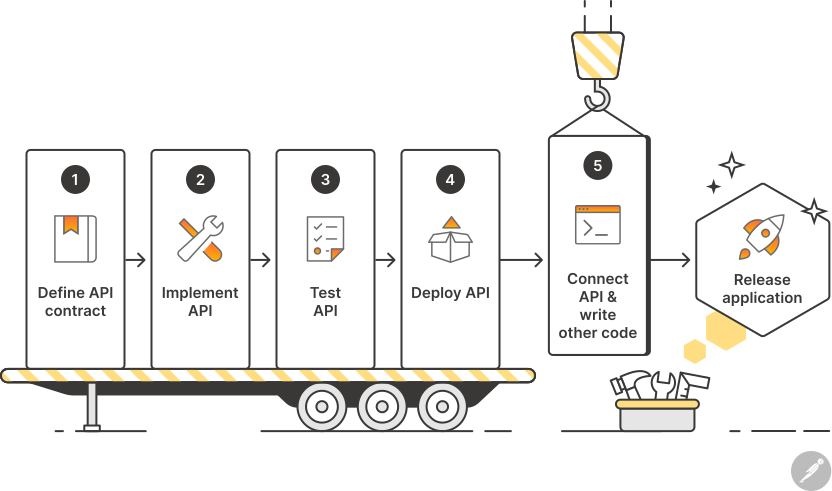
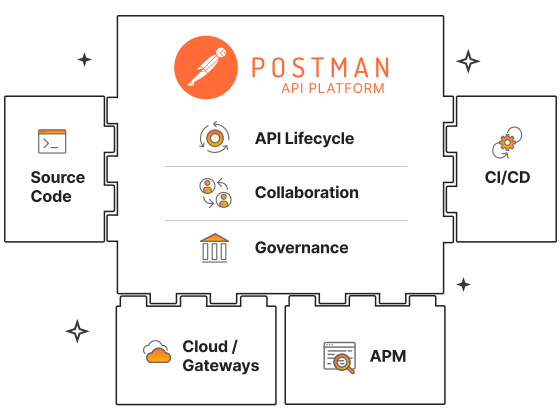
API platforms are software systems with integrated tools and processes that allow producers and consumers to build, manage, publish, and consume APIs. They're a key enabler of API-first, and they have four key components:
Tools for the API lifecycle, including an API client, API design and mocking capabilities, API testing and automation, API documentation, and API monitoring
Collaboration capabilities for producers and consumers, including an API catalog and API workspaces
Governance capabilities for operations, architecture, and security teams, such as API security and observability
Integrations with the software development lifecycle, including source code management, CI/CD, cloud/on-premises infrastructure and application performance management

Navigating the paths to API-first
API-first will save your developer team pain and suffering, and save your organization time and money. But there are several valid routes to API-first. Which is the right one? Some of the most notable are:
Design-led
For many, this is the North Star for many teams that embark on an API-first journey. API design-first is about designing APIs in a collaborative way before you write code or release anything into production.
Code-led
You prioritize coding the API before you code the applications that use it.
Prototype-led
You develop, mock, and document your API using a collection before generating an OpenAPI definition. It is also common to use a proxy or Postman Interceptor to reverse engineer APIs, generating a collection, and then ultimately an OpenAPI from the collection.
Proxy-led
You run your existing API through a proxy or Postman Interceptor, and generate a collection based upon existing traffic.
Collection-led
This involves good old-fashioned handcrafting of a Postman Collection for an existing API and then generating an OpenAPI from that collection.


Curious to learn more about what an API-first looks like? Read our graphic novel!