API platform
Learn what an API platform is and how they enable teams to succeed in an API-first world by harnessing the full potential of APIs—whether they are private, partner, or public.
API Lifecycle
What is the API lifecycle?
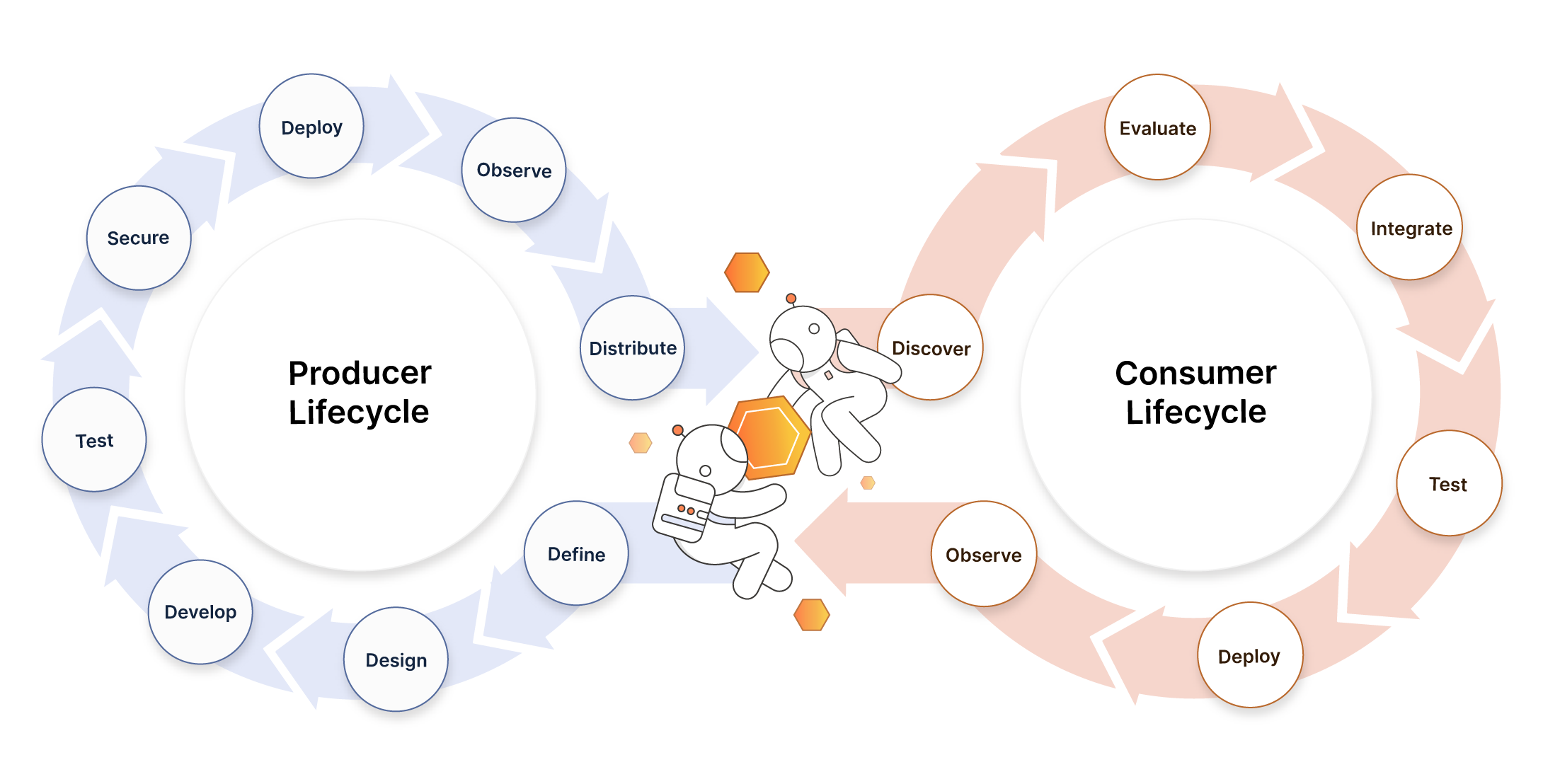
The API lifecycle refers to the series of steps that teams must take in order to successfully design, develop, deploy, and consume APIs. Every API lifecycle is different, but teams that follow a clearly defined lifecycle are more productive and better equipped to deliver a high-quality API. A stable API lifecycle is an essential part of an effective API governance strategy, as it lays the groundwork for stage-specific policies and processes that support collaboration and enable organizations to maximize the value of their API portfolio.
What is an API client?
An API client is a development tool that makes it easier for producers and consumers to explore, test, and debug APIs. Traditional approaches to calling an API require a significant amount of specialized knowledge; for instance, the API user must know a programming language, understand the API's framework and protocol, and be able to interpret the response. API clients abstract away some of this complexity, lowering the barrier to entry for API-related work and enabling teams to stay focused on big-picture goals throughout the API lifecycle.
What is API design?
API design is the process of making intentional decisions about how an API will expose data and functionality to its consumers. A successful approach to API design hinges on a thorough API definition, which describes an API's surface area in a standardized specification format. The API design process benefits both consumers and producers by ensuring that APIs advance business objectives while remaining easy to use, adaptable, testable, and well-documented. API design should occur early in the API lifecycle in order to achieve alignment among key stakeholders and to help teams identify issues before they become ingrained.
What is API documentation?
API documentation is a set of human-readable instructions for using and integrating with an API. It includes detailed information about an API's available endpoints, methods, resources, authentication protocols, parameters, and headers, as well as examples of common requests and responses. Effective API documentation improves the developer experience for private, partner, and public APIs, and teams that prioritize API documentation typically see higher rates of adoption, fewer support tickets, and—in the case of public APIs—increased revenue.
What is API testing?
API testing is the process of validating that an API is working as expected. API testing can be performed manually on an ad-hoc basis, or it can be automated with a testing tool that executes test scripts at predetermined intervals or in response to events. Traditionally, API testing has occurred at the end of the development phase, right before changes are deployed to production, but an increasing number of teams are running tests earlier in the API lifecycle in order to catch issues as quickly as possible.
What is API test automation?
API test automation is the process of using a testing tool to programmatically execute API tests at certain times or frequencies, or in CI/CD pipelines. It is particularly important for agile development teams, as it enables them to maintain fast-paced development cycles while continuously and systematically verifying that their API is working as expected. Teams that automate their API tests are able to deliver new features quickly and confidently while conserving bandwidth throughout the API lifecycle.
What is API monitoring?
API monitoring is the process of gathering, visualizing, and alerting on API telemetry data to ensure that API requests are handled as expected. API monitoring plays an important role in helping teams surface API-related issues—such as errors, latency, and security vulnerabilities—before they escalate and negatively impact dependent services, partners, and customers. Whereas API testing is intended to support rapid iteration in the development stage of the API lifecycle, the primary goal of API monitoring is to reduce the mean time to resolution (MTTR) for consumer-facing problems in production.
What is API observability?
API observability is the extent to which an API's internal state can be understood through its metrics, events, logs, and traces. This telemetry data can be used to create alerts that will notify teams about concerning issues, and it also facilitates ad-hoc exploration and complex analysis that can guide high-level business decisions. API observability plays a crucial role in helping teams monitor their API's performance, troubleshoot issues, understand usage patterns, and identify opportunities for optimization.
Collaboration
What is API collaboration?
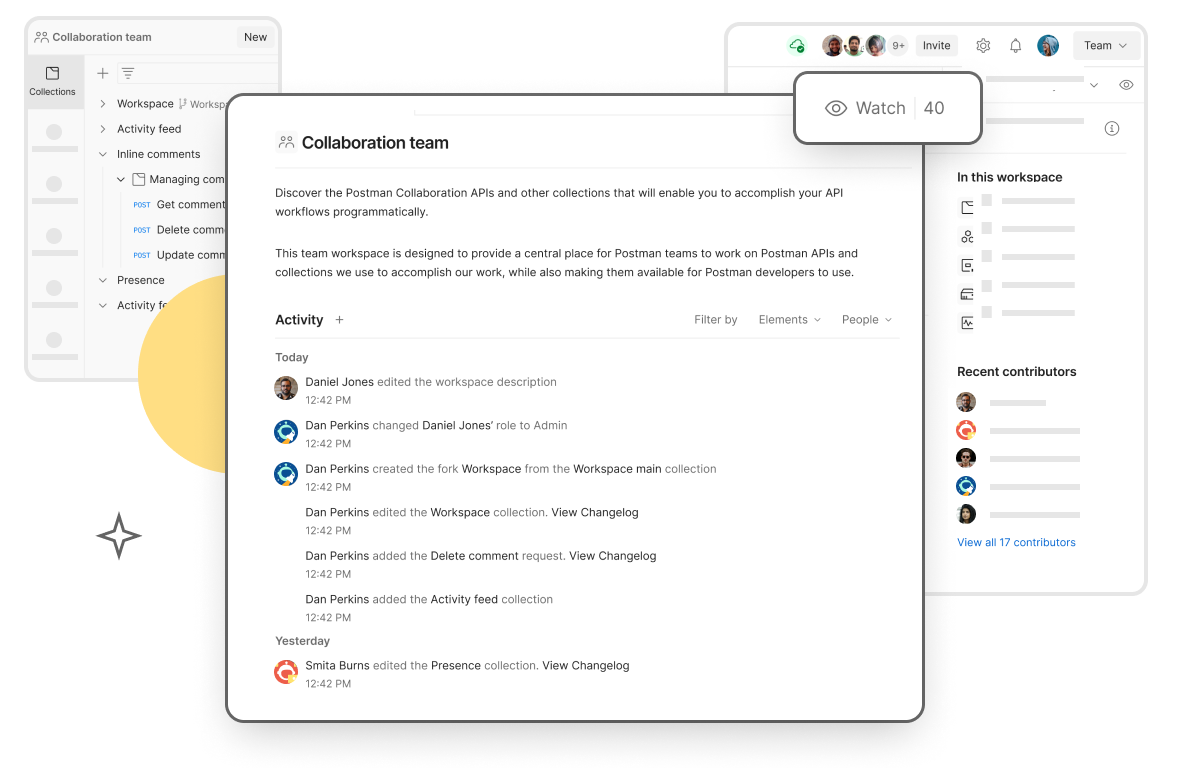
API collaboration is the process through which developers, testers, architects, and other business stakeholders work together to produce and consume APIs. It is a crucial pillar of today's software landscape, in which internal APIs serve as the primary building blocks of applications and drive development efforts. While the API collaboration process will look different for private, partner, and public APIs, it helps ensure that every API remains consistently available, highly performant, easy to use, and able to meet consumer needs.
What is an API catalog?
An API catalog is a searchable, highly-organized library of available APIs that makes it easier for consumers to find and use the APIs they care about. Private API catalogs contain every internal API within an organization, which streamlines the API management process by helping teams identify redundant code and follow organization-wide standards. In contrast, public API catalogs connect API producers with third-party consumers, which fosters developer communities, shortens feedback loops, and generates revenue.
Governance and security
What is API governance?
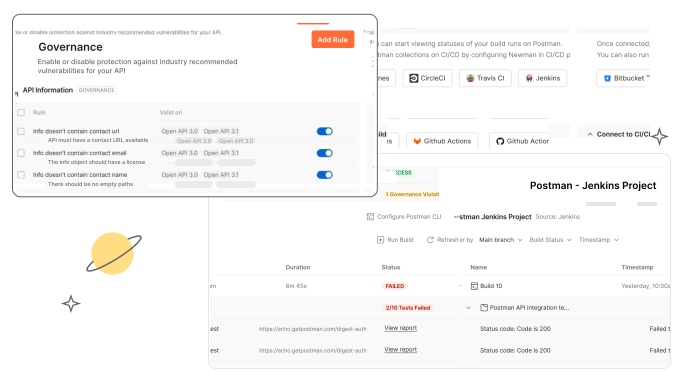
API governance is the practice of defining policies and processes that foster effective collaboration, promote API consistency, and enable organizations to get the most value out of their API portfolio. A successful approach to API governance involves advocacy, enablement, and training, which helps establish a governance-oriented mindset across the organization. This cultural shift increases productivity, streamlines API workflows, improves the consumer experience, and reduces risk. The resulting APIs are reusable, stable, secure, compliant with legal regulations, and aligned with the organization's goals.
What is API security?
API security is the practice of preventing and mitigating attacks that originate at the API level, and it is a crucial pillar of any organization's overall security strategy. APIs not only enable users to interact with applications, but also facilitate communication between their underlying internal services—many of which transmit or store sensitive data. An insecure API can therefore provide an entry point for attackers and seriously compromise an application's security posture.
Third-party integrations
Which third-party tools do API platforms integrate with?
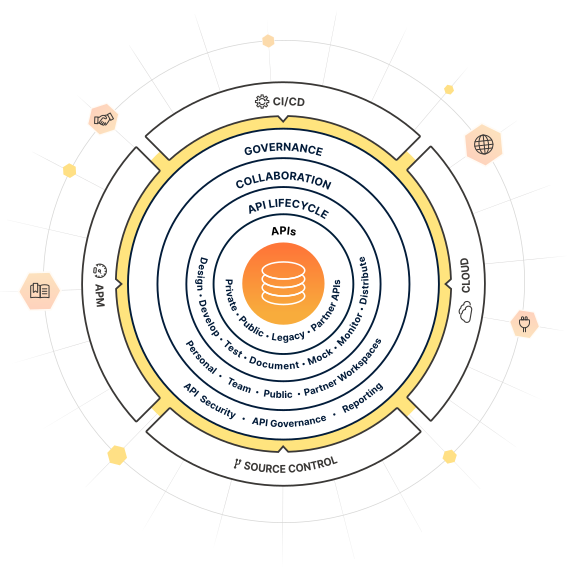
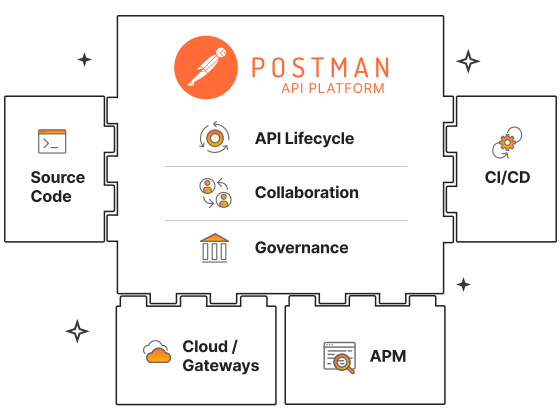
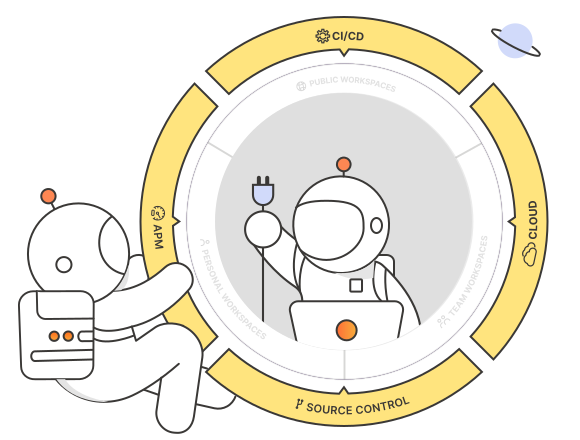
The software development lifecycle (SDLC) is complex, and every team relies on a variety of third-party tools to help them develop, deploy, and monitor their APIs. For instance, they might use GitHub or GitLab for source code management, Jenkins or CircleCI for continuous integration and deployment (CI/CD), AWS or Azure for cloud infrastructure and gateways, and Datadog or New Relic for application performance monitoring (APM). An API platform must therefore provide seamless integrations with these tools in order to support and augment existing workflows.
Get started with Postman